Via Scott Markwell (WRD) and Paula Dempsey (Library):
Follow-up to our recent discussions on curating portfolios
Via Dana Dunham and Brainpickings.org:
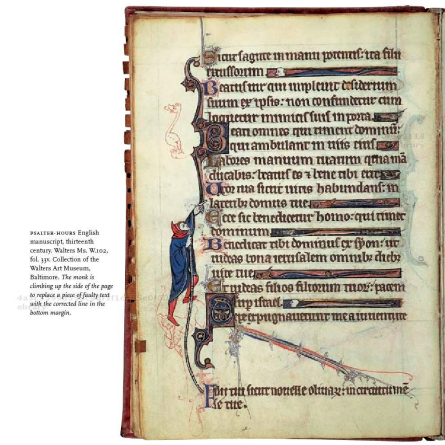
Lately, the word “curate” seems to be used in an greater variety of contexts than ever before, in reference to everything from a exhibitions of prints by Old Masters to the contents of a concept store. The risk, of course, is that the definition may expand beyond functional usability. But I believe ‘curate’ finds ever-wider application because of a feature of modern life that is impossible to ignore: the incredible proliferation of ideas, information, images, disciplinary knowledge, and material products that we all witnessing today. Such proliferation makes the activities of filtering, enabling, synthesizing, framing, and remembering more and more important as basic navigational tools for 21st century life. These are the tasks of the curator, who is no longer understood as simply the person who fills a space with objects but as the person who brings different cultural spheres into contact, invents new display features, and makes junctions that allow unexpected encounters and results. […]
“Blogs vs. Term Papers”? or public, interactive discourse …
This article, from last week’s NYT Education Life section is better and more interesting than the title — “Blogs vs. Term Papers” — suggests. In fact, it is nicely contextualized with some current thinking in literacy studies, including this, from Andrea Lunsford:
“We’re at a crux right now of where we have to figure out as teachers what part of the old literacy is worth preserving,” says Andrea A. Lunsford, a professor of English at Stanford. “We’re trying to figure out how to preserve sustained, logical, carefully articulated arguments while engaging with the most exciting and promising new literacies.”
Professor Lunsford has collected 16,000 writing samples from 189 Stanford students from 2001 to 2007, and is studying how their writing abilities and passions evolved as blogs and other multimedia tools crept into their lives and classrooms. She’s also solicited student feedback about their experiences.
Her conclusion is that students feel much more impassioned by the new literacy. They love writing for an audience, engaging with it. They feel as if they’re actually producing something personally rewarding and valuable, whereas when they write a term paper, they feel as if they do so only to produce a grade.
Winter & Spring Quarter D-WRD Meeting Times
Meeting times: 10:00-11:00 a.m.
143 McGaw Hall.
Friday, January 20th:
- Planning for WQ
- Discussion item: “themes” and metaphors in student digital portfolios
Friday, February 3rd:
Friday, February 17th:
- Reading: Randall McClure: “WritingResearchWriting: The Semantic Web and the Future of the Research Project.” Computers and Composition. Volume 28, Issue 4, December 2011, Pages 315–326. [Direct DePaul Library link].
- Overview of the “curated model” of student digital portfolios in Digication
Friday, March 2nd:
- Reading: We’ll be discussing Dennis Baron’s “From Pencils to Pixels: The Stages of Literacy Technology”
- Activity: Alternatives to the image-editing program Picnik, which is closing down –
Anne Wysocki Visits
Copyright & Fair Use Workshop: Friday, 11/4
Background for Friday:
- 17 U.S.C. § 107 : US Code – Section 107: Limitations on exclusive rights: Fair use
- Brief glosses on those limitations on exclusive rights (Stanford Univ.)
- RiP: A remix manifesto. 2010 documentary available for free viewing on Hulu (90 minutes).
- Alternatives to the Preemptive Criminalization of Students: Productive and Ethical Classroom Practices in Copyright & Fair Use (Moore)
AQ 2011 D-WRD Schedule
Digital WRD is a professional-development working group that meets twice a month, 1st and 3rd Fridays, to discuss — and to develop a culture of mutual support for — teaching with technology, with attention to access, equity, and agency:
- We discuss historical and contemporary research related to technology, rhetoric, literacy, and pedagogy
- We share and workshop assignments that we’re trying out in our classes for feedback
- We develop collective expertise in areas such as multimodal composing, digital portfolios, social media, and online communication
- We provide mutual support for learning new technology platforms — digital, audio, video, textual, graphic — and integrating them in our teaching and learning
- We compose teaching and project portfolios where you can reflect on and present your teaching and professional work in any number of contexts in support of your professional development
Handy list of local DePaul / FYW technology links
Campus Connect – the portal to all things DePaul — especially employee and instructor info, course rosters, grades, and teaching evaluations.
First Year Writing Teaching Resources — teaching resources, syllabi, assignments, readings, faculty development.
First Year Writing Digital Portfolios & Digication – student and instructor resources; examples, assessment, workshop materials.
(more…)
Special Issue: Kairos — A Journal of Rhetoric, Technology, and Pedagogy
Shannon Carter, Guest Editor
SPECIAL ISSUE: (Re)mediating the Conversation: Undergraduate Scholars in Writing and Rhetoric
Undergraduate research is distingushed by four characteristics: mentorship, originality, acceptability (in terms of the relevant disciplinary research methods and techniques), and dissimination. (see Hakim, 1998, p. 190)
It is with great pleasure and pride that we introduce you to (Re)mediating the Conversation: Undergraduate Scholars in Writing and Rhetoric, a Kairos special issue dedicated to undergraduate research in new media.
Background
As teachers and scholars in new media, we’ve long craved a vehicle like this—a scholarly context building on the tradition of successful print-based journals dedicated to undergraduate scholarship and the Kairos tradition of publishing cutting-edge, multimodal scholarship.
“Remixing the Personal Narrative Essay” resource from Zac Brenner
Thanks, Zac!
In light of Saturday’s focus on multimodal assignments (and the new learning outcomes), I wanted to pass along the link to an e-journal called Currents in Electronic Literacy, which is published by the University of Texas at Austin: http://currents.cwrl.utexas.edu/. The current issue is dedicated to multimodal literacy and pedagogy, with a particular emphasis on sound and text.
The specific article that I was thinking about on Saturday is called “Remixing the Personal Narrative Essay,” and I think it’s relevant for those who are interested in teaching the literacy narrative as a multimodal piece and keeping it in 103: http://currents.cwrl.utexas.edu/2011/remixingthepersonalnarrative. The article details how a personal narrative essay was remixed as a multimodal assignment, and it includes the assignment prompt and the final product as well.
Although most of us won’t be able to visit a recording studio with our students, there are a number of ways to replicate this type of assignment with the resources available at DePaul. In general, I thought it was just a nice example of outside-the-box thinking for those of us who are interested in revamping the literacy narrative to make sure that it’s complex enough to warrant inclusion in 103.
From the article’s opening paragraph:
Is the English classroom ready to go multimodal? As Bill Cope and Mary Kalantzis point out, the changing social and technological landscape has led to “meaning [being] made in ways that are increasingly multimodal—in which written-linguistic modes of meaning are part and parcel of visual, audio, and spatial patterns of meaning” (5). According to a recent report sponsored by the MacArthur Foundation, “more than one-half of all teens have created media content” (Jenkins 3), suggesting that students are more than ready for the English classroom to go multimodal. Perhaps a better question is: Where to begin?
Two new resources from Scott Johnson
Thanks, Scott!
A discussion by Andrea Lunsford on plagiarism and the problems posed by students who view research materials as “open source” documents that don’t need to be cited in a traditional way.

A book — Writing Assessment and the Revolution in Digital Texts and Technologies, which was recommended to me by an old friend / colleague
New book on Fair Use; possible D-WRD workshop?
Integrating new communication technology in writing courses inevitably leads to questions and concerns about intellectual property, copyright law, and fair use privileges. A new book — Reclaiming Fair Use – addresses many of these issues in ways that will benefit writing teachers and those of us interested in culture, technology, law, and literacy practices.
(more…)
Welcome new and returning faculty and colleagues, 2011-12
Digital WRD is a professional-development working group that meets twice a month, 1st and 3rd Fridays, to discuss — and to develop a culture of mutual support for — teaching with technology, with attention to access, equity, and agency:
- We discuss historical and contemporary research related to technology, rhetoric, literacy, and pedagogy
- We share and workshop assignments that we’re trying out in our classes for feedback
- We develop collective expertise in areas such as multimodal composing, digital portfolios, social media, and online communication
- We provide mutual support for learning new technology platforms — digital, audio, video, textual, graphic — and integrating them in our teaching and learning
- We compose teaching and project portfolios where you can reflect on and present your teaching and professional work in any number of contexts in support of your professional development
Teaching & Learning Certificate
From DePaul’s Teaching Commons: The Teaching & Learning Certificate Program is a workshop-based program for all full- and part-time faculty at DePaul who are interested in enriching their teaching practices in collaboration with colleagues from across the university.
To attain a Teaching & Learning Certificate, instructors complete a minimum of six workshops within two years. The workshop series begins with an introduction to the Digication e-Portfolio platform, which is used throughout the program to develop a teaching portfolio. The workshop series culminates in a reflective teaching portfolio workshop.
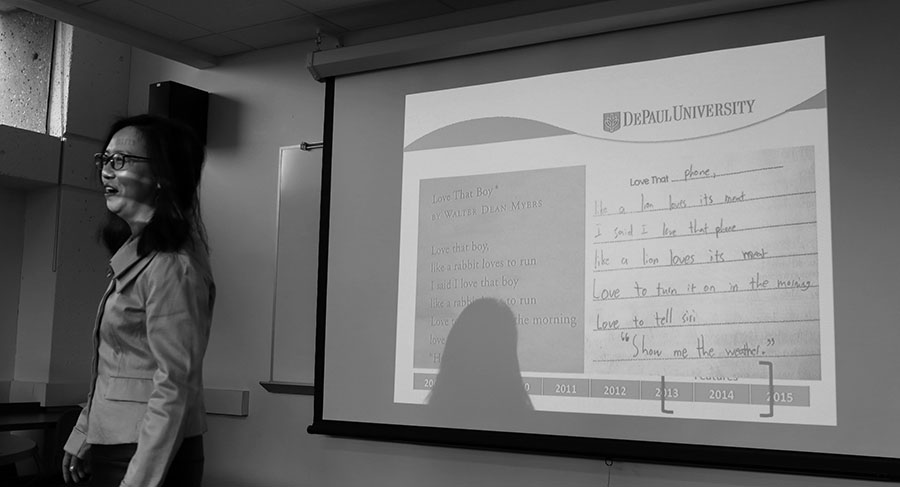
Handwriting in the Digital Age
From the Diane Rehm show, 28 July: “The decline of cursive is happening as students are doing more and more work on computers, including writing. In 2011, the writing test of the National Assessment of Educational Progress will require 8th and 11th graders to compose on computers, with 4th graders following in 2019.”
Expanding First-Year Writing Learning Outcomes
- Students will be able to articulate, for multiple audiences, meaning-making capabilities of textual, graphic, auditory, and video modes
- Students will be able to compose in multiple modes with intended rhetorical effects, and to articulate the steps they took to achieve those effects
- Students will be able to contextualize meaning-making capabilities of multimodality for academic, professional, and community audiences

Image from “A Pedagogy of Multiliteracies: Designing Social Futures.”
Harvard Educational Review, New London Group, 1996.
Computers and Writing 2012 CFP
The theme of the 2012 conference is: Architexture: Composing and Constructing in Digital Spaces. This theme encourages submissions that look at a variety of aspects focused on the production of digital texts in the writing classroom, from changes in process and publication to administrative and practical challenges to implementing multi-modal compositions. We will support this theme in a variety of creative and, we hope, engaging activities to encourage conference goers both participate actively in the conference and re-think production.
http://chasslamp.chass.ncsu.edu/~cw2012/
North Carolina State University, Raleigh, NC
Onsite Conference: Thursday, May 17, 2012 – Sunday, May 20, 2012
Proposal Submission Opens: September 1, 2011
Proposal Due Date: October 22, 2011 (before midnight EST)
Notifications of Acceptance: December 15, 2011
Registration Opens: January 15, 2012
Online Conference: Dates to be announced
Keynote Speakers: David Parry, Alex Reid, Anne Wysocki
Digication & digital portfolios, 2010-11 recap
As of May 15th, 2011:
DePaul courses that have at least one Digication assignment: 154
DePaul students who have participated in Digication courses: 2181
DePaul faculty who have used Digication: 129
# of WRD courses that have used Digication: 125
# of WRD students who have used Digication: 1846
# of WRD faculty who have used Digication: 54
D-WRD Professional Development: Readings & Inquiry, 2011-12
So that we can attend to some of the intellectual contexts for our work with students and with technology, the D-WRD Working Group is gathering summer readings to share in preparation for our meetings and workshops next year.
For starters, this summer, these two work well as a pair:
- “A Pedagogy of Multiliteracies: Designing Social Futures.”
Harvard Educational Review, New London Group, 1996. - “Live and Learn: Why We Have College.”
Louis Menand, The New Yorker, June 6, 2011.
Then, in the fall:
- “Designs for Social Futures.”
Ch. 10 in Multiliteracies: Literacy Learning and the Design of Social Futures, 2000. - “Writing Program Administration and Instructional Computing.”
Ken McAllister and Cynthia Selfe. The Writing Program Administrator’s Resource. Lawrence Erlbaum, 2002. - “Writing, Technology and Teens.”
Pew Internet & American Life Project, 2008. - Academically Adrift: Limited Learning on College Campuses, Arum and Roksa, University of Chicago Press, 2010. Excerpts on writing and critical thinking.
- “Digital Diploma Mills: The Automation of Higher Education.” David Noble. First Monday, 1998.
Some of the questions that we can pursue together:
- What do we know about writing? How do we know it? How should we teach it?
- What theory of language or discourse informs your classroom practice?
- How are changes in higher education and the shifting purposes for attending college affecting our understanding of media, technology, literacy, and learning?
- What is the relationship between Vincentian social values and teaching with technology?
- “What are the instructional goals of the writing program? How can these goals be made to drive a computer-based program/course/activity/facility/decisions?” and “Who is being served by these goals and the computer-based instruction that is derived from them? Who is not?” (McAllister & Selfe 345)
![]()