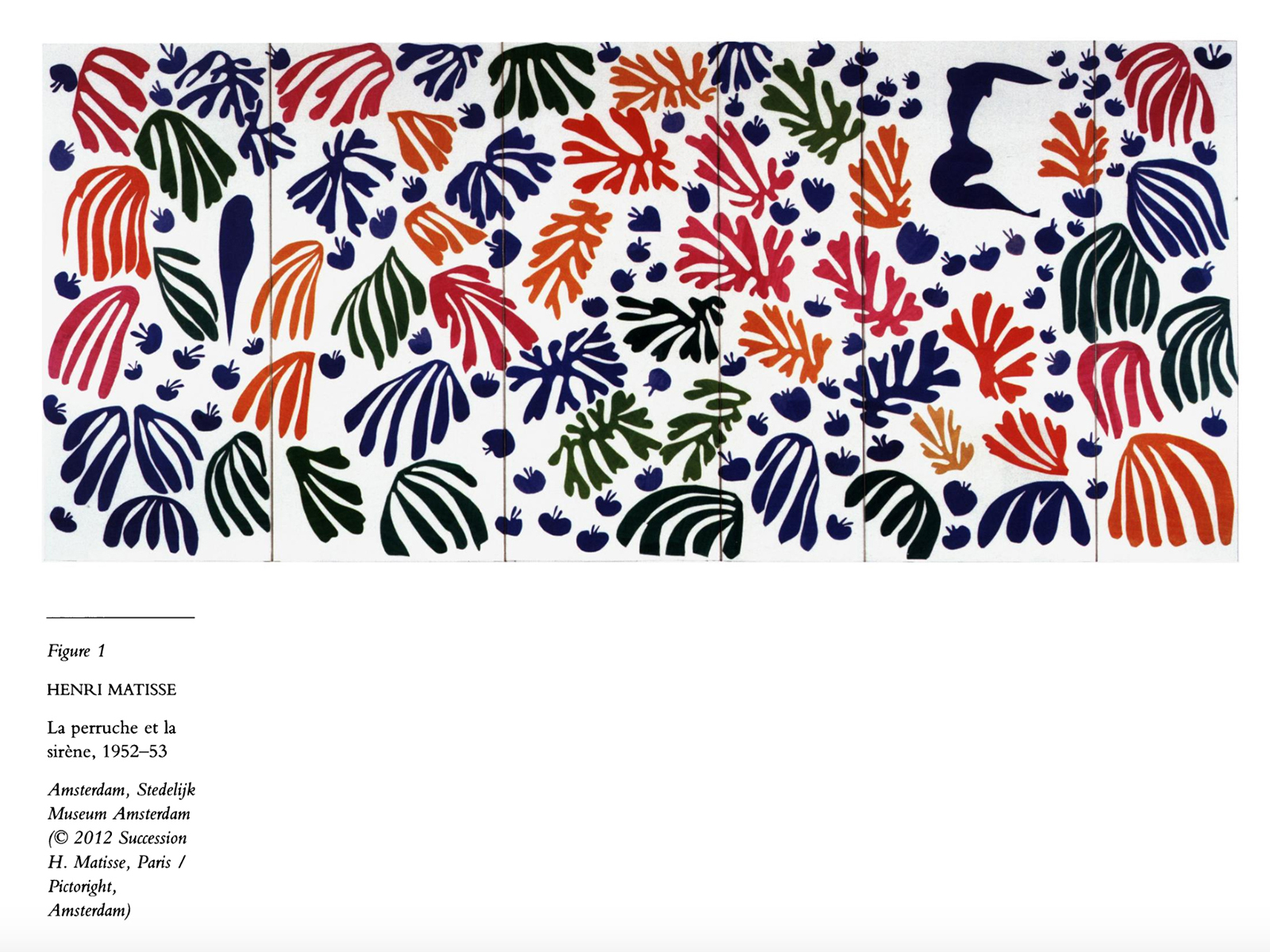
- MOMA: The Cut Outs
- Stedelijk Museum, The Oasis of Matisse
- Verbeek: Matisse’s Installation of “La perruche et la sirène” as an Environment: An Immersive Experience. Master Drawings, Vol. 50, No. 2. 2012: 187-192.

DePaul University, Chicago & Impractical Labor in Service of the Speculative Arts (ILSSA)
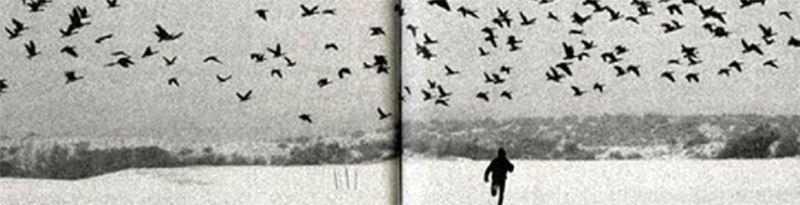

“This story is partly told in the useful biographical note that has been written for the American edition by Lois Ames. The novel was initially rejected by its American publisher and when, after its success in England, Harper & Row sought to publish it, they were refused permission by the family. Sylvia Plath’s mother has insisted that her daughter thought of the book as a “pot-boiler” and did not want it published in the United States. And Mrs. Plath herself felt that the book presented ungrateful caricatures of people who had tried to help her daughter. These sentiments are understandable. But a book published in England cannot be kept away from the United States. Already, the student underground has been smuggling copies from abroad into the country. Literature will out. And “The Bell Jar” is not a pot-boiler, nor a series of ungrateful caricatures: it is literature. It is finding its audience, and will hold it.”
“The Harper & Row edition is overdue, but very welcome and handsomely done. It has one of the best jacket designs (by Amy Isbey Duevell) I have ever seen, and it includes reproductions of eight pen-and-ink drawings by Sylvia Plath. The drawings are landscapes and still lifes, caught by a meticulous draftsman, who understands almost too well what it means to work in a medium where black is the only color.”
— Scholes review: “Esther came back like a retreaded tire,” April 11, 1971
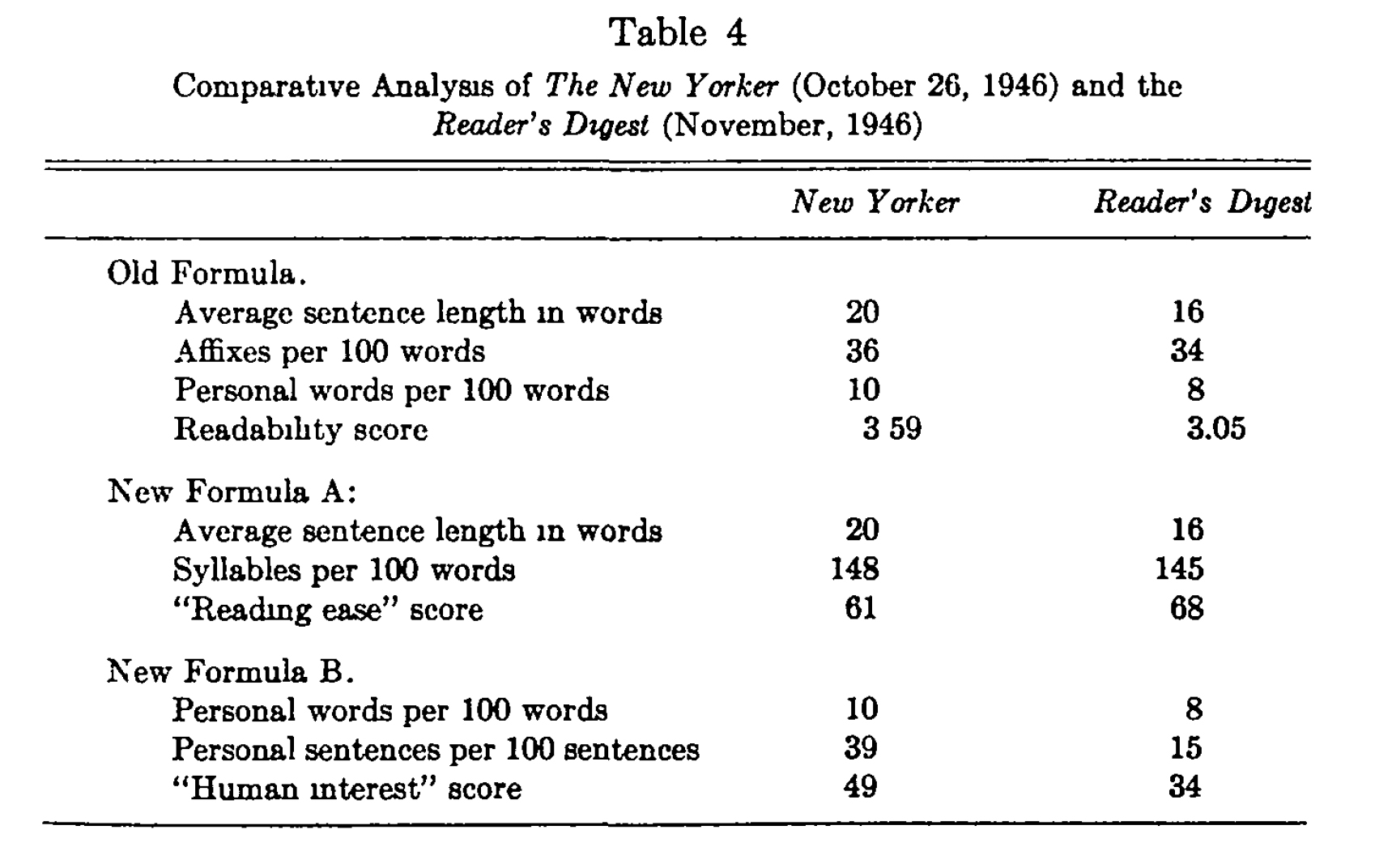
Click image for larger, readable version:

“Expressionism vs. Impressionism.” Design. 50 (1949). (Now known as Arts Education Policy Review.)
“I do not say this because I feel dissatisfied with my present station – no, God forbid: – for everybody and everything conspire to make me as contented as possible in it; yet I have too much of the vanity of human affairs to expect felicity from the splendid scenes of public life. I am still determined to be cheerful and to be happy in whatever situation I may be, for I have also learnt from experience that the greater part of our happiness or misery depends upon our dispositions, and not upon our circumstances; we carry the seeds of the one, or the other about with us, in our minds, wherever we go.”
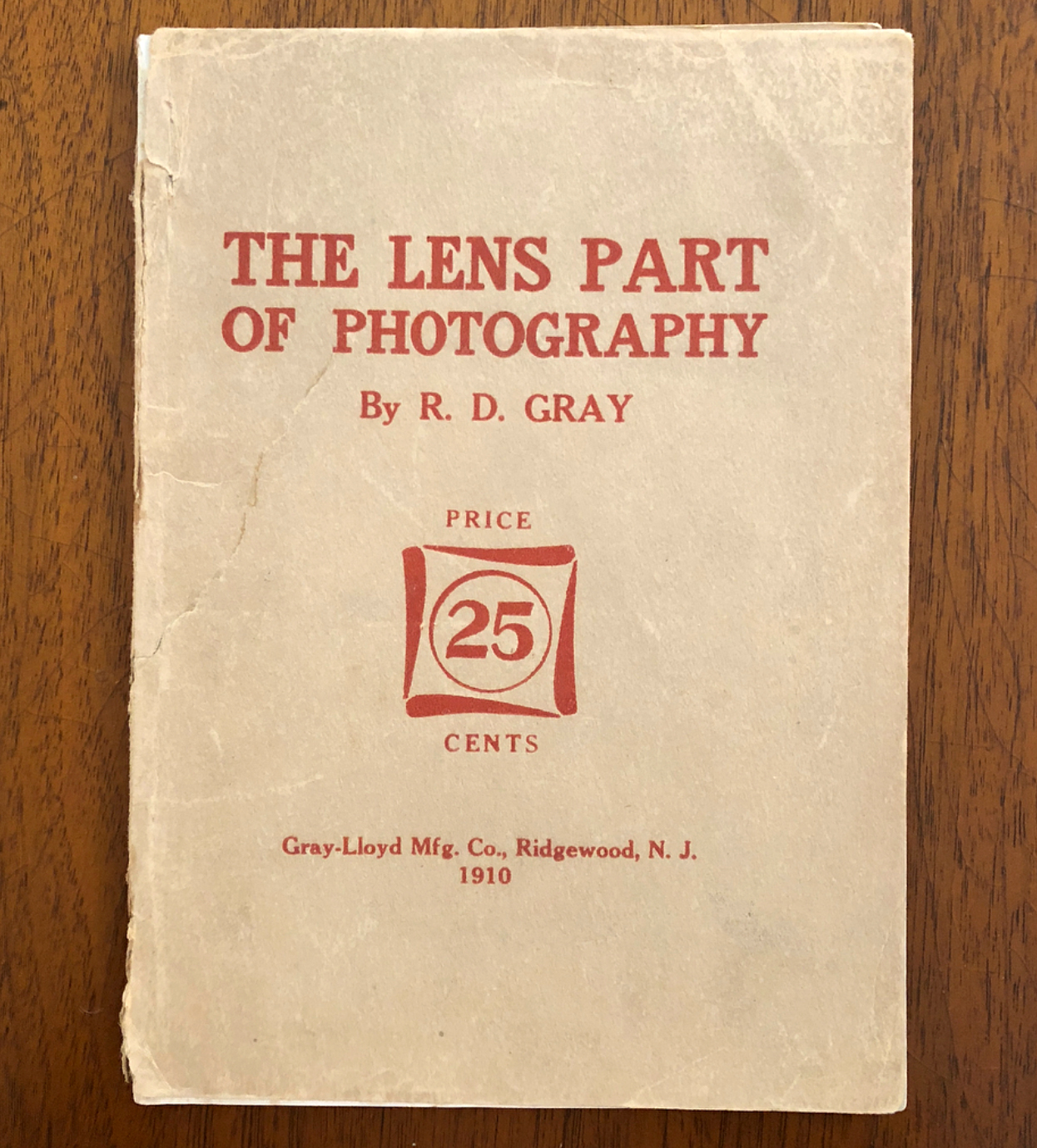
“The above is the title of a surprisingly large twenty-live cents’ worth of practical in- formation concerning photographic lenses, their properties, functions, and use. It is written by R. D. Gray, a gentleman whose practical and technical knowledge of photographic optics qualifies him to speak authoritatively. The book is well illustrated, both with the necessary diagrams to supplement the text and examples of photographic work of different kinds. Some idea of the contents may be gathered from a few of the chapter headings, amongst which are: Testing Lenses, Table of View Angles. Copying, Shutter Efficiency, and Photographing Tall Buildings.”
“Copies can be obtained, postpaid, upon receipt of twenty-five cents, from Gray, Lloyd & Company, Ridgewood, New Jersey.”
— Description from Camera Craft: A Photographic Monthly.
Volume XVIII, San Francisco, 1911.
some “proper spring”
this is!
snow at the gate
— Issa (1822)
Spring
To what purpose, April, do you return again?
Beauty is not enough.
You can no longer quiet me with the redness
Of little leaves opening stickily.
I know what I know.
The sun is hot on my neck as I observe
The spikes of the crocus.
The smell of the earth is good.
It is apparent that there is no death.
But what does that signify?
Not only under ground are the brains of men
Eaten by maggots.
Life in itself
Is nothing,
An empty cup, a flight of uncarpeted stairs.
It is not enough that yearly, down this hill,
April
Comes like an idiot, babbling and strewing flowers.
— Edna St. Vincent Millay (1937)

“To come right out with it, this is a book on rhetoric. Its purpose is to help you in your writing.
“Chances are, you learned how to write-indirectly-from Aristotle. Look up the history of English grammar, composition, and rhetoric teaching; you’ll find that it all started a couple of centuries ago when people first hit upon the idea of teaching English-speaking boys and girls not only Greek and Latin, but English too. Courses and textbooks came into being; naturally, what was taught was simply Greek and Latin grammar and rhetoric, applied to English. Now since all Greek and Latin grammar and rhetoric go straight back to Aristotle (as any encyclopedia will tell you) and since the principles of English teaching are still much the same as they were two hundred years ago, what you were taught in school really comes down from Aristotle.
“So, whether you like it or not, you are an umptieth-generation Aristotelian.”
— Chapter 1: “You and Aristotle”
“Reading is a hugely complex task, one that calls upon many parts of the brain, but it is not a skill humans have acquired through evolution (unlike speech, which is largely hard-wired). Reading is a relatively recent development, arising perhaps 5,000 years ago, and it depends on a tiny area of the brain’s visual cortex. What we now call the visual word form area, or V.W.F.A., is part of a cortical region that evolved to recognize basic shapes in nature, but can be redeployed for the recognition of letters or words. This elementary shape or letter recognition is only the first step.”
“From this visual word form area, two-way connections must be made to many other parts of the brain, including those responsible for grammar, memories, association and feelings, so that letters and words acquire their particular meanings for us. We each form unique neural pathways associated with reading, and we each bring to the act of reading a unique combination not only of memory and experience, but of sensory modalities, too. Some people may “hear” the sounds of the words as they read (I do, but only if I am reading for pleasure, not when I am reading for information); others may visualize them, consciously or not. Some may be acutely aware of the acoustic rhythms or emphases of a sentence; others are more aware of its look or its shape.“
— Oliver Sacks: “Reading the Fine Print”
“Millennials” has become a sort of snide shorthand in the pages of The Wall Street Journal. We have blamed them for the housing shortage, their fickle shopping habits or for fleeing New Jersey. We have had a laugh at their expense over behaviors such as a fear of doorbells or their discovery of the TV antenna. And at other times we have treated them like an alien species (“If You Have 29 Credit Cards, You’re Probably a Millennial” or “Facts to Silence Your Smug Millennial Nephew This Thanksgiving”). Comedian and late-night host Stephen Colbert even mocked our coverage on an episode of “The Late Show.” What we usually mean is young people, so we probably should just say that. Many of the habits and attributes of millennials are common for people in their 20s, with or without a snotty term.
But it is worth remembering, too, that millennials are an important group of WSJ readers (not to mention many of your colleagues). We risk alienating them if we write about them with such disdain. Increasingly, we are not just covering how economists or marketers perceive this generation. We are writing for and about a group of people who are building major companies, altering the way we work and live and challenging long-held notions of family and society.
Let’s also be precise when referring to this group and resist the temptation to use stereotypes, apply a blanket label or let the term become a crutch in our stories. Occasionally, we’ve referred to millennials when we really meant teenagers. Millennials, also known as Generation Y, are commonly defined as people born from about 1980-2000. That means the oldest millennials are approaching 40 and the youngest are seniors in high school. Such explanations are worth including in articles that are centered on millennials.
— WSJ Style & Substance: Vol. 30, No. 11: Millennials
— WSJ Style & Substance archive

“Remember Democracy never lasts long. It soon wastes exhausts and murders itself. There never was a Democracy Yet, that did not commit suicide. It is in vain to Say that Democracy is less vain, less proud, less selfish, less ambitious or less avaricious than Aristocracy or Monarchy. It is not true in Fact and no where appears in history. Those Passions are the same in all Men under all forms of Simple Government, and when unchecked, produce the same Effects of Fraud Violence and Cruelty. When clear Prospects are opened before Vanity, Pride, Avarice or Ambition, for their easy gratification, it is hard for the most considerate Phylosophers and the most conscientious Moralists to resist the temptation. Individuals have conquered themselves, Nations and large Bodies of Men, never.“
— John Adams, in a letter to John Taylor, 17 December 1814
“In the art world of the 1960s and 1970s, the photograph came to have a multiplicity of functions: it could document a performance (as in the art of Carolee Schneemann), advocate a social message (Danny Lyon), underpin a conceptual practice (Sol LeWitt), or relate a fictional narrative (Eleanor Antin). And today, now that cameras are ubiquitous and cloud-compatible, we often expect photography to serve as a tool for other efforts. But a photograph can still — we forget sometimes — have no function than to be itself.”
That autonomous virtue comes through loud and clear at the Museum of Modern Art’s retrospective of Stephen Shore’s work: a sprawling, demanding exhibition that sticks up for photography as a discipline in its own right. Mr. Shore, who emerged in the 1970s alongside William Eggleston, Joel Sternfeld and other pioneers of color photography, has spent decades shooting landscapes and highways, motel rooms and diner breakfasts, with an unaffected mastery and subtle humor. Not staged, not lit, not cropped, not retouched, his photographs are feats of dispassionate representation, and yet their attentiveness and exactitude make them far, far more than snapshots.
NYT/Farago: Stephen Shore’s MoMA Survey Shows a Restless Reformer as a Master of Photography

I first saw David Carson’s work, as did a number of others, in the short-lived magazine called Beach Culture, and I immediately wondered what the hell was 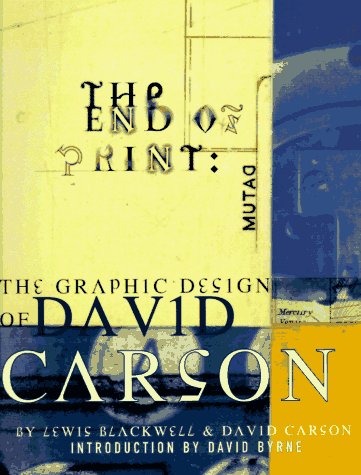 going on. Who was reading this amazing magazine that seemed to be in the wrong place, directed at the wrong audience? It seemed to act like a popular mag, but sure didn’t look like one. Were surfers really into this radical design? Were they actually more savvy than I gave them credit for? Well, Southern California was the home of Kustom Kars and Low Riders, both examples of beautiful, radical, impractical design of and by the people. Maybe this was another step along those lines? Popular culture proving once again that it could be more revolutionary than high culture.
Then Beach Culture disappeared and we never found out the answers.
I was beginning to despair that rock music culture was becoming square, conservative, stuck. The mass-market mags were all towing some kind of party line, getting excited when they were suposed to, and narrowing their interests and focus until the world started becoming a suburban backyard. And that was what we were trying to escape from!
Then along came Ray Gun, and hey, it’s that guy again! Now we’re talking.
Design was cool again! Suddenly, visual expression was, as we always knew it was, as hip as Rock & Roll. Even the readers were contributing great drawings, paintings and sketches. This was not an isolated designer freaking out, but a catalyst for who knows how many people who knew that there is no difference between anything anymore-between “professional” musicians/artists and amateurs.
For decades, public art programs have tried to “bring art to the people”; museums and great institutions of learning strive to “enlighten the masses”. When all along the “masses” have been doing it for themselves-maybe unrecognized, and in slightly different forms. With guitars and offset fanzines. With kustom kars, surfboards and skateboards.
I suppose a lot will be made of David Carson’s work being the perfect example of Mcluhan’s theory of sprung life-that when a means of communication has outlived its relevance, it becomes a work of art. That print-books, magazines, news-papers will become icons, sculptures, textures-that they will be a means of communication of a different order, and that simple information transfer will be effected by some other (electronic) means. Print will no longer be obliged to simply carry the news. It will have been given (or will have taken, in this case) its freedom, and there is no going back. Print is reborn, resurrected, as something initially unrecognizable. It’s not really dead, it simply mutated into something else.
David’s work communicates. But on a level beyond words. On a level that bypasses the logical, rational centers of the brain and goes straight to the part that understands without thinking. In this way it works just like music does-slipping in there before anyone has a chance to stop it at the border and ask for papers.
— From the Introduction of End of Print by David Byrne (Carson, 1995).

“For more than four decades, Gould has been a landmark in search of a purpose, beyond being an awe-inspiring assembly space and a retreat where students — many of whom are adults with jobs, families and tough lives — can briefly immerse themselves in the calming “sound of time,” as Thomas Wolfe said about Pennsylvania Station (also by McKim, Mead & White).”
“The central rotunda is encircled with 16 columns of richly veined green Connemara marble. Hundreds of rosettes stud the deep coffers of the gilded dome. Glimpsed behind the classical statuary around the drum of the dome are the words of Job 28: “Where shall wisdom be found? Where is the place of understanding?””
“The answer used to be: all around the rotunda, where the library stacks were constructed with translucent glass floors to permit the greatest amount of daylight to reach the shelves.”
“Above the main floor, much remains as it was when the books and maps and geological specimens were moved out. The doors of small study rooms, tucked along a balcony between the big Connemara columns, are still labeled “Greek,” “Latin,” “Semitic,” “Romance,” “German,” “English.””
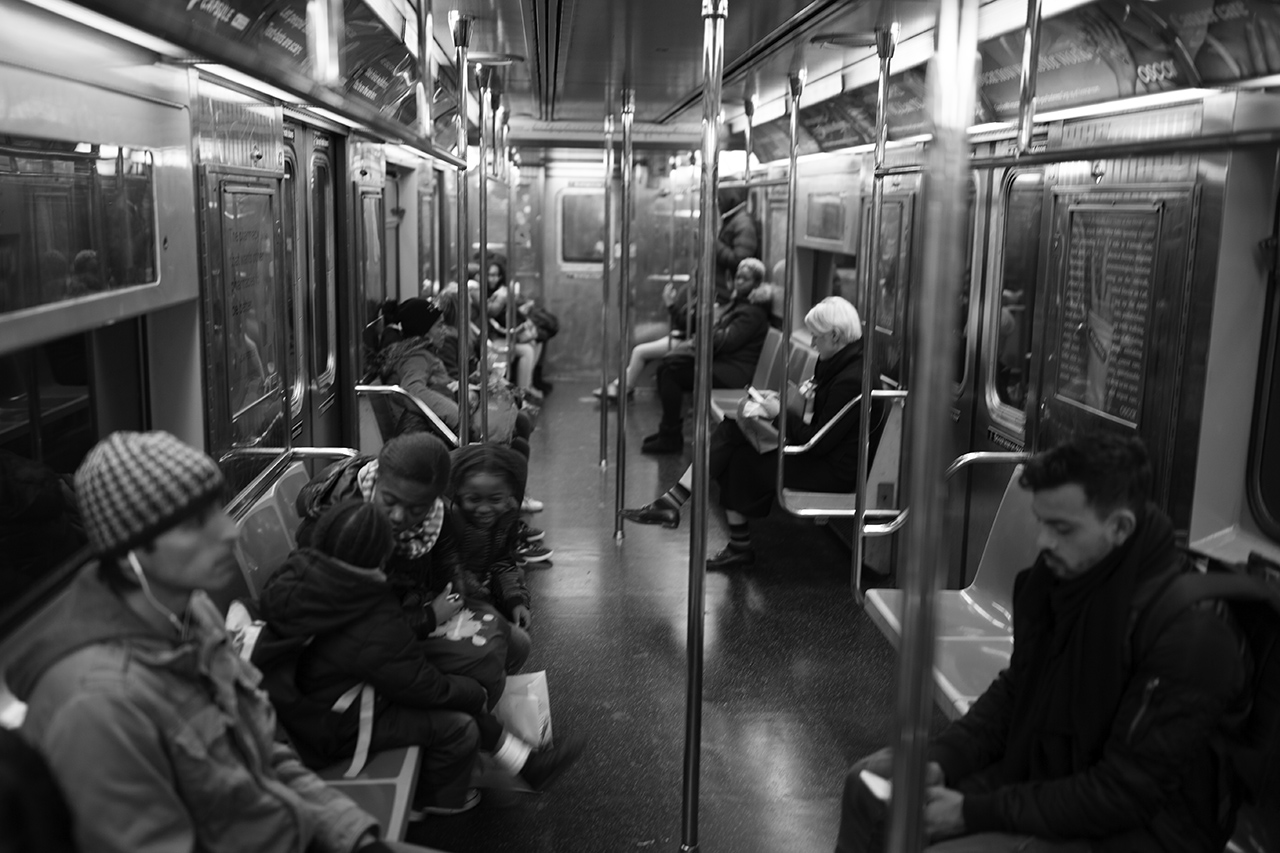 The #1 Train
 Jane Addams, Bronx Community College
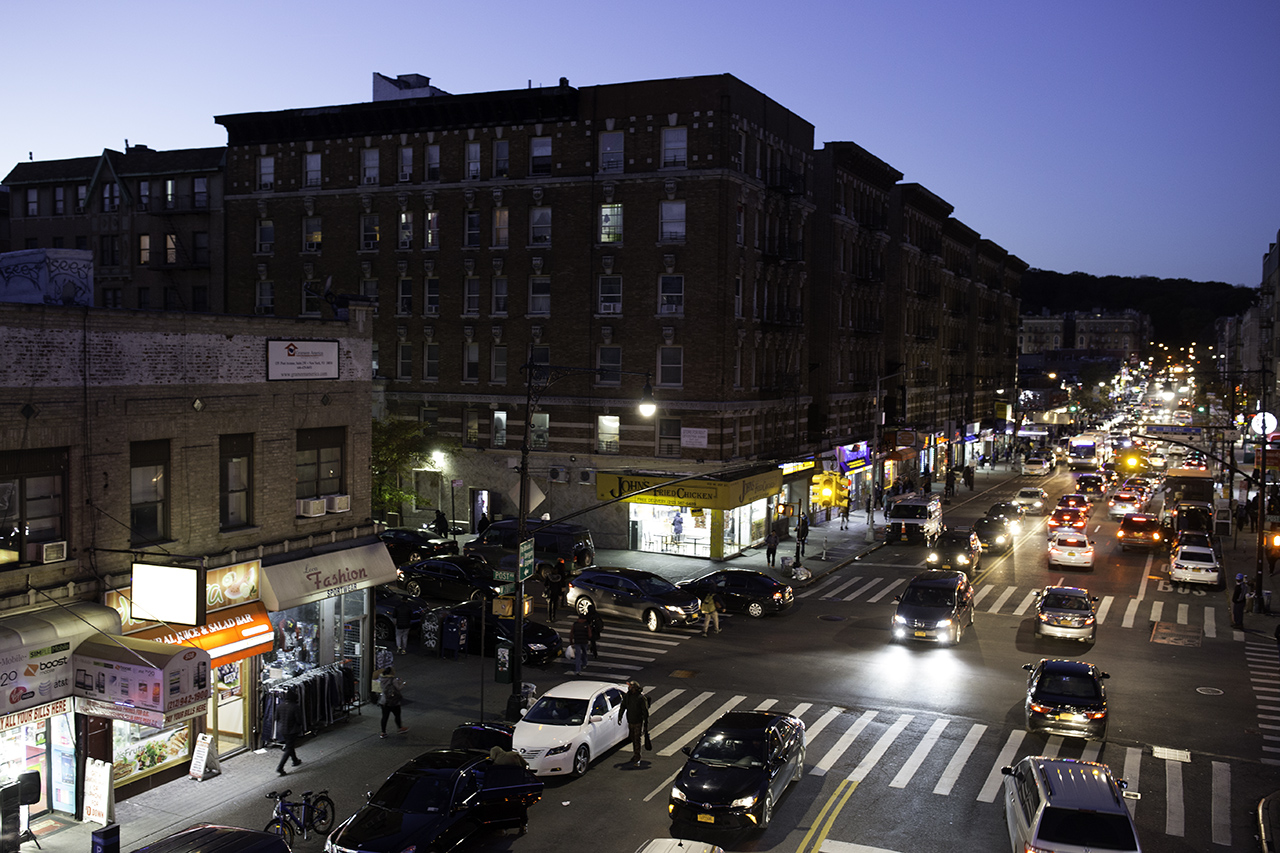 207th Street, Bronx
 207th Street, Bronx
 Flatiron Building
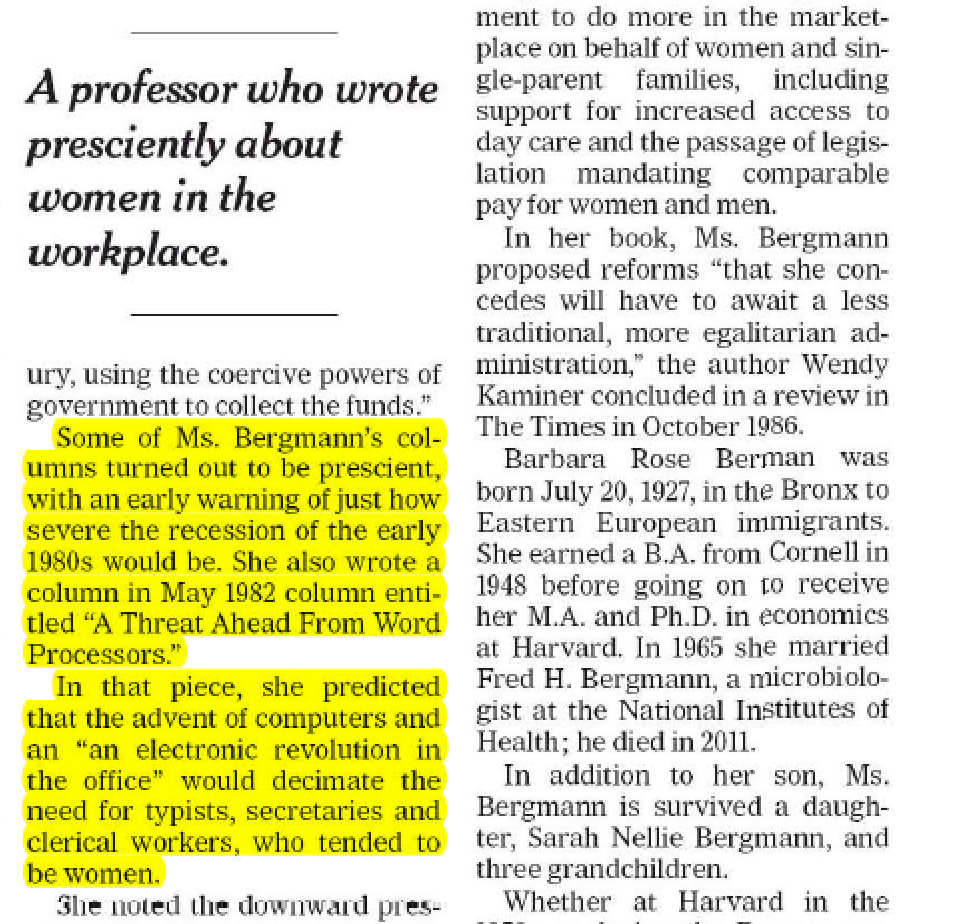
NYT Obituary: “Barbara Bergmann, Trailblazer for Study of Gender in Economics, Is Dead at 87”
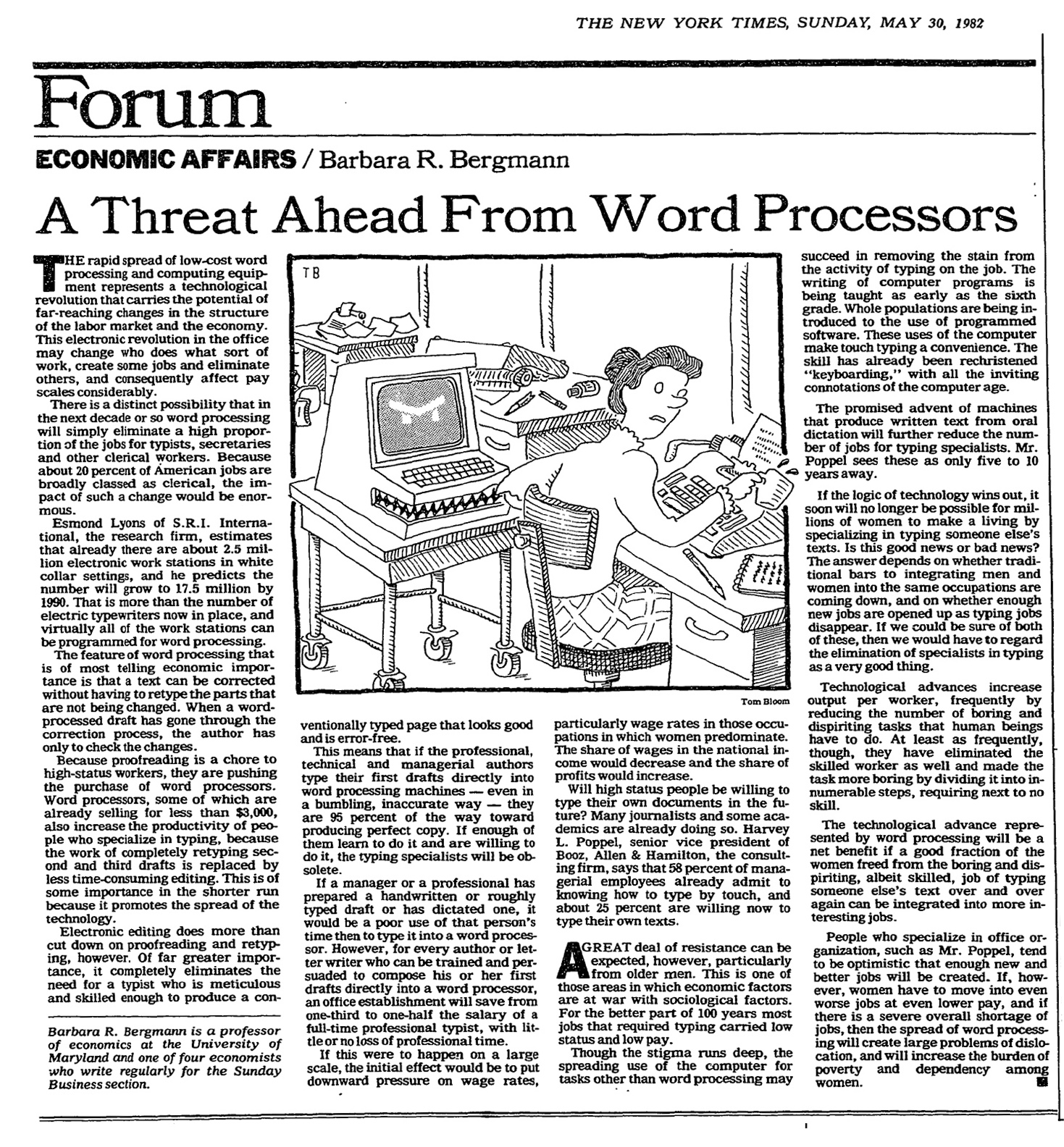
NYT/Bergmann, “A Threat Ahead from Word Processors” (PDF) — and check out the early-80’s typography while you’re there, especially the advertisement in the lower left-hand corner.
Ina`a `ohe nalu, a laila aku i kai, penei e hea ai:
(If there is no surf, invoke seaward in the following manner)
“Ku mai! Ku mai! Ka nalu nui mai Kahiki mai,
(Arise! Arise! You great waves from Kahiki)
Alo po i pu! Ku mai ka pohuehue,
(The powerful curling waves. Arise with the pohuehue)
Hu! Kai ko’o Loa.”
(Well up long raging surf.)
If there was a dearth of waves, the appointed priest would take several strands of pohuehue (Hawaiian Morning Glory flower) and in unison with a swimming party, would swing the vines around and lash them “unitedly upon the water until the desired undulating waves were obtained.”
— Finnery & Houston, Surfing: Sport of Hawaiian Kings, 1966.
 Ambrogio Bondone (Giotto), 1309 A.D.
My little sisters, the birds, much bounden are ye unto God, your Creator, and always in every place ought ye to praise Him, for that He hath given you liberty to fly about everywhere, and hath also given you double and triple raiment; moreover He preserved your seed in the ark of Noah, that your race might not perish out of the world; still more are ye beholden to Him for the element of the air which He hath appointed for you; beyond all this, ye sow not, neither do you reap; and God feedeth you, and giveth you the streams and fountains for your drink; the mountains and valleys for your refuge and the high trees whereon to make your nests; and because ye know not how to spin or sow, God clotheth you, you and your children; wherefore your Creator loveth you much, seeing that He hath bestowed on you so many benefits; and therefore, my little sisters, beware of the sin of ingratitude, and study always to give praises unto God.
— Saint Francis of Assisi, c.1220
Acceleration occurs in two related ways. First, in the smaller sense, literacy technologies and practices tend toward speed. That is, they aim to achieve some end faster. Second, in the large sense, literacies can accelerate: appearing, changing, merging with other literacies, or fading at a faster rate. For instances of literacies appearing, one must only think of the fact that MySpace, Facebook, and Twitter all arrived within a three-year span, 2003–2006, and quickly became popular literacy practices. A form of literacy can rise to importance and fall out of practice in a short amount of time.
For instance, knowing how to use hypertext markup language (HTML code) was an important aspect of electronic literacy in the 1990s, but is now fading. Some teachers may recall developing pedagogies around multiuser domains (MUDs), Second Life, and MySpace; these, too, have largely faded. An established form of literacy may remain but in an altered form. E-mail was a dominant form of electronic communication in various life domains, but has lost most of its social use to Facebook and texting, leaving it to fulfill the more formal communication needs of business and education. As literacies remain, they change: web browsers have moved from multiple windows to multiple tabs for multitasking purposes and continuously offer extensions to control more of the online experience; Facebook continues to update its functions and appearance; and cell phones have added keyboards for faster texting, application software (apps) for specific tasks, and speech recognition and activation software (e.g., Siri for the iPhone).
A significant effect of accumulation and acceleration is that what counts as effective reading and writing becomes a moving target—over time and from context to context. People in various situations must keep up with the latest changes, whether they involve using Facebook for social purposes, employing social media for workplace goals, or learning the latest course management software. Literacies are increasingly tied to contexts that value and reinforce speed and brevity. Much has been written to disparage “fast literacies” such as text messaging and multitasking, with the implied or openly stated conclusion that education should provide a bulwark against these anti-intellectual practices (Carr 2010; Edmundson 2004; Faigley 2006). I respond to some of these criticisms throughout the book and articulate a nuanced, productive relationship between “slower” and “faster” forms of literacy. If we take accumulation and acceleration as defining features of contemporary literacy, then a goal for educators should include helping students gain versatile, dexterous approaches to both reading and writing so they are prepared to navigate a wide range of ever-changing literacy contexts.
From Daniel Keller, Chasing Literacy: Reading and Writing in an Age of Acceleration.
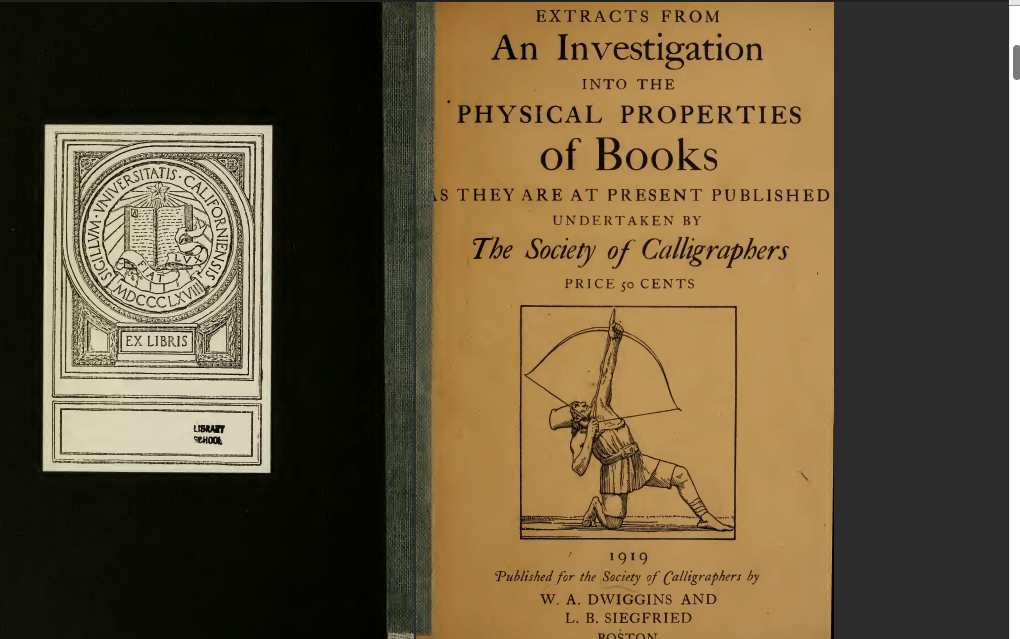
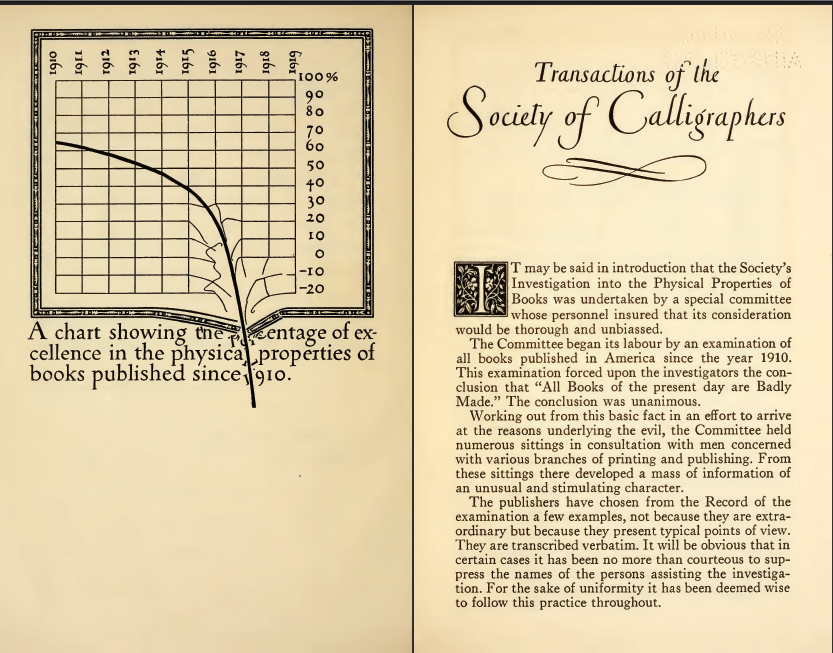
Investigation Into the Physical Properties of Books, as They are at Present Published (1919) a satire on — and a parody of — book designers and the emerging field of book design.
“At the close of World War I [Dwiggins] had served as acting production manager of the Harvard University Press and had formed a very low opinion of the practices followed by publishers and book manufacturers. In 1919, Dwiggins and Siegfried created a fake series of interviews with publishing magnates and book salesmen, delighting in exposing the shoddy quality of most trade books and the cavalier attitudes of the people who made them. Extracts from An Investigation into the Physical Properties of Books as They Are at Present Published covered twenty pages (plus four blanks) and sold for fifty cents. This time the publisher was The Society of Calligraphers, another fiction created by Dwiggins to aid him in his commentaries about graphic arts and printing. This modest booklet caused a major stir in the book world of the time, and certainly contributed to Dwiggins’ visibility as a discerning designer of books; nevertheless, it was not until 1926 that he began to receive regular commissions for book design.”
From “The Private Press Activities of William Addison Dwiggins,” Parenthesis series, Fine Press Books Association.
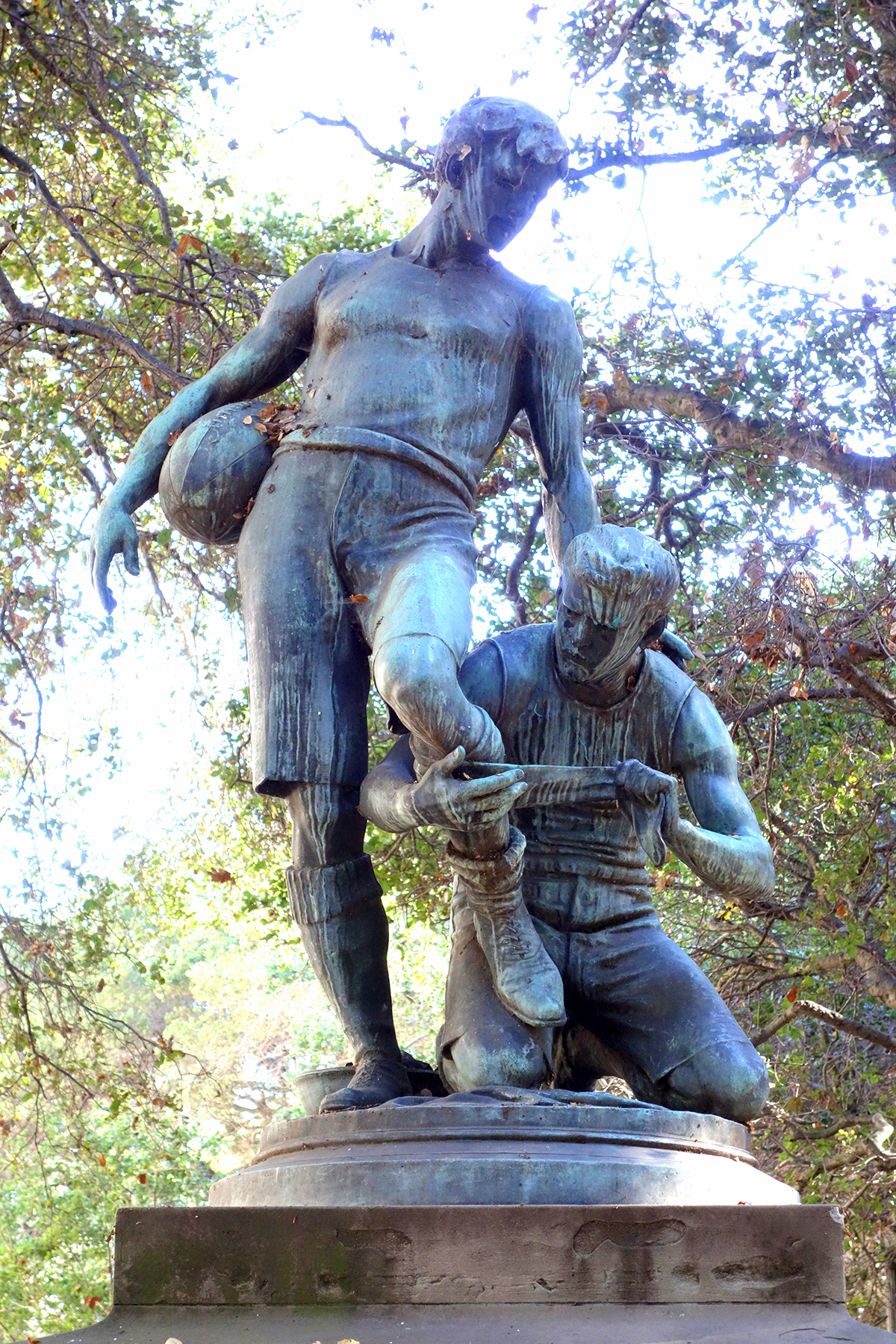
Berkeley’s first campus statue: “In Paris he came into his own as a sculptor, creating works that won him awards and admiration. One of these, dated 1893, was “The Football Players”—two young male figures, based on French models, wearing what we might today describe as rugby or track and field uniforms.”
“Cal, which had an undistinguished record to date against Stanford, rallied in response to the incentive and with the help of professional coach and former Princeton star Garrett Cochran soundly beat Stanford in 1898 and 1899.”
“It was sited along the path between what was then the football field to the north, and the gymnasium to the southeast, and was the first piece of permanent outdoor art installed on the campus.”

“The rule which seems to cover best the words of this group reads: “In diphthongs, i before e except after c or when sounded like a as in ‘neighbor’ and ‘weigh.’ ” Notice the phrase “in diphthongs.” “In the same syllable” might be substituted for this phrase. Usually this rule is stated without the prefixing phrase. In this case five more exceptions to the rule must be added to the eleven already mentioned, a total of sixteen exceptions.”
“The value of this rule seems fully as doubtful as that of the third rule. One hundred and one, about 2.6 per cent, of the words in the spelling list are covered by it. Eleven words, about 0.3 per cent, in the list are exceptions. In other words, the number of exceptions is about i i per cent of the number of words covered by the rule.”
Wheat, Leonard B., “Four Spelling Rules.” Elementary School Journal, 32, 1932, pp. 697-706.
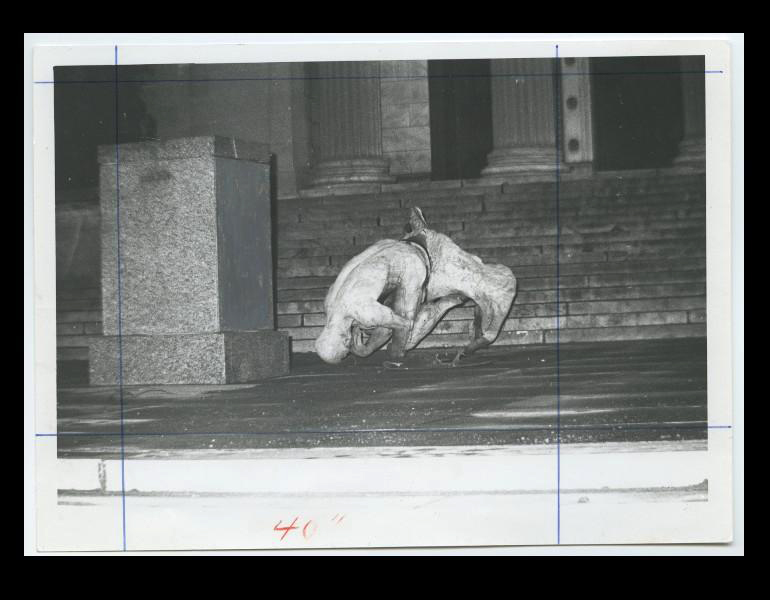
“At approximately 1:00 am on March 24, 1970, a bomb irreparably damaged the Cleveland museum’s version of The Thinker. The bomb itself had been placed on a pedestal that supported the enlargement and had the power of about three sticks of dynamite.
“No one was injured in the subsequent blast, but the statue’s base and lower legs were destroyed. The remaining sections of the cast were blown backward to form a ‘plume’ at the base, and the entire statue was knocked to the ground. It was reported that this attack was undertaken by a radical political group, perhaps as a commentary on the continuing military action in Vietnam or the elitism of the American government.
“Regardless, no one was ever arrested or charged with the destruction. However, the incident highlighted several conservation issues related directly to artistic intent. Since the piece was so dramatically damaged, the museum was unsure how to proceed. One idea was to create an entirely new cast to replace the damaged work. Another idea was to restore the sculpture by recasting elements of Rodin’s original. Finally, however, it was decided that the statue should not be repaired, but placed outside the museum in its damaged condition.
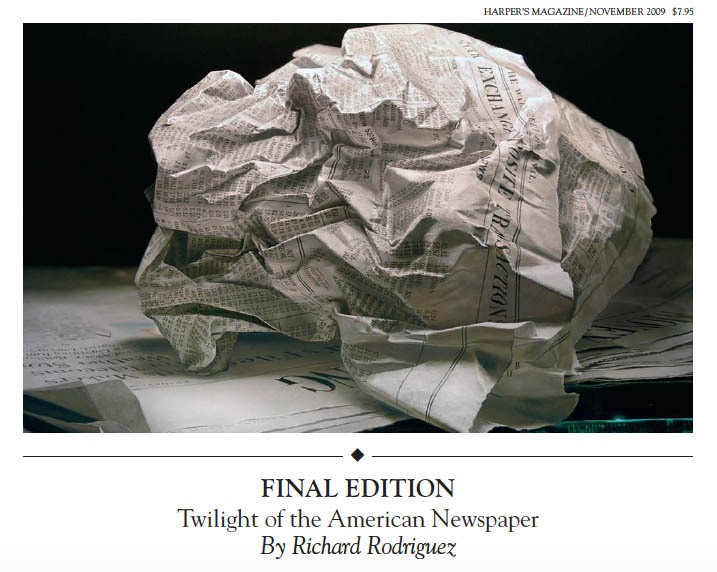
Because the teacher had once been to Chicago, she subscribed to the Sunday edition of the Chicago Tribune, which came on the train by Tuesday, Wednesday at the latest. Several generations of children learned to read from that text. The schoolroom had a wind-up phonograph, its bell shaped like a morning glory, and one record, from which a distant female voice sang “Ah, Sweet Mystery of Life.” Is it better to have or to want? My friend says her teacher knew one great thing: There was something out there. She told her class she did not expect to see even a fraction of what the world had to offer. But she hoped they might.
[…]
It was the pride and the function of the American newspaper in the nineteenth century to declare the forming congregation of buildings and services a city—a place busy enough or populated enough to have news. Frontier American journalism preserved a vestige of the low-church impulse toward universal literacy whereby the new country imagined it could read and write itself into existence. We were the Gutenberg Nation.
[…]
Unwilling to forfeit any fraction of my quarter, I even studied the classifieds— unrelieved columns laid out like city blocks: Room for rent. Marina. No pets. File clerk position. Heavy phones. Ticket agent for busy downtown box office. Must be bonded. Norman, we’re still here. Only once did I find the titillation I was looking for, a listing worthy of a barbershop magazine, an Argosy, or a Mickey Spillane: “Ex- Green Beret will do anything legal for cash.” Newspapers were sustained by classifieds, as well as by department-store ads and automobile ads. I admired the urbanity of the drawings of newspaper ads in those years, and I took from them a conception of the posture of downtown San Francisco. Despite glimpses into the classified life of the city, despite the hauteur of ad-art mannerism, the Chronicle offered some assurance (to an adolescent such as I was) it would have been difficult for me to describe. I will call it now an implied continuity.
[…]
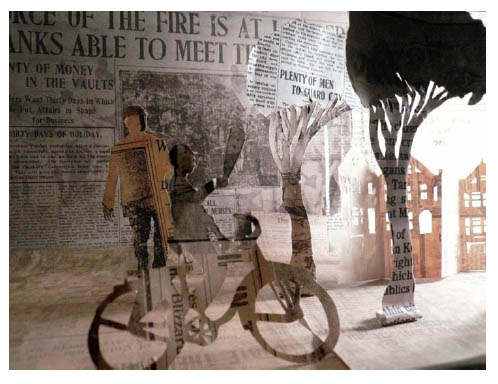
In the nineteenth-century newspaper, the relationship between observer and observed was reciprocal: the newspaper described the city; the newspaper, in turn, was sustained by readers who were curious about the strangers that circumstance had placed proximate to them. So, I suppose, it is incomplete to notice that the San Francisco Chronicle has become remiss in its obituary department. Of four friends of mine who died recently in San Francisco, not one wanted a published obituary or any other public notice taken of his absence. This seems to me a serious abrogation of the responsibility of living in a city and as good an explanation as any of why newspapers are dying. All four of my friends requested cremation; three wanted their ashes consigned to the obscurity of Nature. Perhaps the cemetery is as doomed in America as the newspaper, and for the same reason: we do not imagine death as a city.
[…]
In this morning’s paper there is a quote from an interview San Francisco’s mayor, Gavin Newsom, gave to The Economist concerning the likelihood that San Francisco will soon be a city without a newspaper: “People under thirty won’t even notice.”
[…]
Something funny I have noticed, perhaps you have noticed it, too. You know what futurists and online-ists and cut-out-the-middle-man-ists and Davos-ists and deconstructionists of every stripe want for themselves? They want exactly what they tell you you no longer need, you pathetic, overweight, disembodied Kindle reader.
[…]
We already live in the America of USA Today, which appears, unsolicited, in a plastic chrysalis suspended from your doorknob at a Nebraska Holiday Inn or a Maine Marriott. We check the airport weather. We fl y from one CNN Headline News monitor to another. We end up where we started. An obituary does not propose a solution.
[…]
In the growling gray light (San Francisco still has foghorns), I collect the San Francisco Chronicle from the wet steps. I am so lonely I must subscribe to three papers—the Wall Street Journal, the New York Times, the San Francisco Chronicle. I remark their thinness as I climb the stairs. The three together equal what I remember.
— Richard Rodriguez, “Final Edition: Twilight of the American Newspaper.” Harper’s, November 2009.

By submitting his work to this procedural analysis, Ligon emphasizes the degradation not only of the material components, but also the subject matter, through reproduction and prolonged exposure. He has described how the process of making Condition Report served as a temperature gauge for the cultural moment, in relation to his ongoing concerns as an artist:
it’s a return to my own production, but in the case of those prints that came out of the condition report, it was about detailing not only the physical aging of the painting over time – all the cracks and paint loss and all of that – but also changing ideas about masculinity, changing ideas about the relationship we have to the Civil Rights Movement.
Exhibited together, the paired panels of Condition Report reveal the passage of time with regard to political history as well as the changing status of the art object.
Via Tate Museum
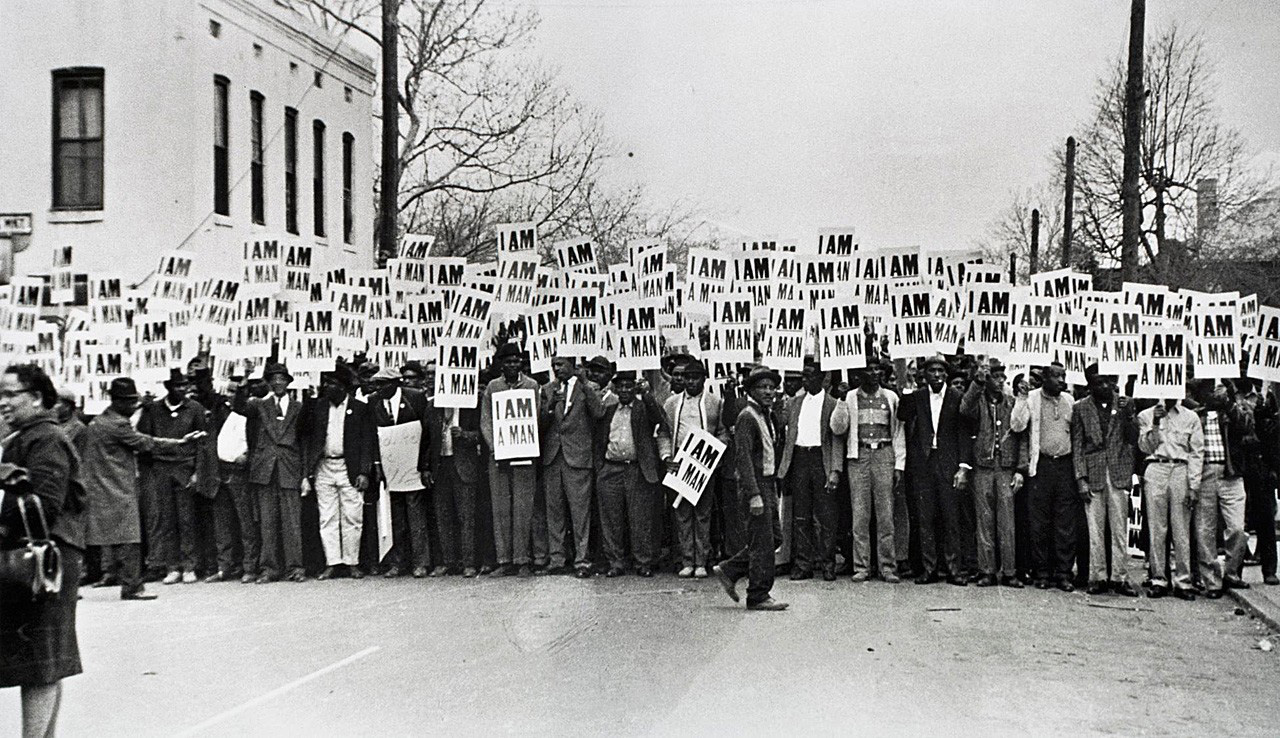
Original context: Memphis Sanitation Workers Strike, 1968
Longstanding tensions between disgruntled African American sanitation workers and Memphis city officials erupted on February 12, 1968 when nearly one thousand workers refused to report to work demanding higher wages, safer working conditions, and recognition of their union, local 1733 of the American Federation of State, County, and Municipal Employees. Despite organizing city-wide boycotts, sit-ins, and daily marches, the city’s sanitation workers were initially unable to secure concessions from municipal officials. At the urging of Reverend James T. Lawson, Martin Luther King, Jr. agreed to come to Memphis and lead a nonviolent demonstration in support of the sanitation workers. On March 29 over five thousand demonstrators, carrying signs which read “I Am A Man,” participated in King’s march.
Civil Right Museum, I Am A Man
Chicago Teacher’s Strike, 2016:

“Whenever I want my cat to look at something instructive — a full moon, say, or a photograph of herself — a predictable choreography ensues. I point at the thing I want her to look at, and she, roused to curiosity, fixes her attention on the tip of my extended index finger and begins to explore it with delicate sniffs.
“Every time this scene of failed pedagogy gets enacted (and it’s frequent, because I am no better at learning not to point than my cat is at learning not to sniff) the two of us are caught in a pedagogical problematic that has fascinated teachers of Buddhism since Sakamuni. In fact, its technical name in Buddhist writing is ‘pointing at the moon,’ and it opens up a range of issues about both language and the nonlinguistic that became engaging to Western teachers and learners only in the twentieth century.”
— Eve Sedgewick: Touching Feeling: Affect, Pedagogy, Performativity, 2003.
sweet spontaneous
earth how often have
the
doting
fingers of
prurient philosophers pinched
and
poked
thee
, has the naughty thumb
of science prodded
thy
beauty, how
often have religions taken
thee upon their scraggy knees
squeezing and
buffeting thee that thou mightest conceive
gods
(but
true
to the incomparable
couch of death thy
rhythmic
lover
thou answerest
them only with
spring)
e. e. cummings

“Writing is an act of community. It is a letter, it is comforting, consoling, helping, advising on our part, as well as asking it on yours. It is a part of our human association with each other. It is an expression of our love and concern for each other.” — Dorothy Day