WRD 103: Composition & Rhetoric I Rotating Header Image

Concluding with the New York Times

The end of the term coincided with a campus visit by Angela Kluwin, Executive Director for Education at the New York Times. Some of the students from this term and from previous terms (Katie Klietz, 2010, for example) met with Angela for lunch and a fruitful discussion on reading the NYT in college.

Knowledge or Credentials?

This article — “Our Universities: Why Are They Failing?” — appears in a publication, The New York Review of Books, that we’re not reading, but I was struck by how closely it resembles our ongoing conversation on “what is the purpose of college?”

Tuesday’s Remix Workshop


(more…)

Ms. Hyrnko, 11:20 section

image title

Let’s test our Textual Analysis expertise

From the WSJ, 10/31:

The downfall of MF Global has led one investment bank to disclose its exposure to the now bankrupt futures and commodities brokerage. In a short statement, Jefferies says its exposure to MF’s debt securities is less than $9 million in marked-to-market positions, which it says “resulted from facilitating client orders as part of normal-course market making.”

No word on what led to the disclosure, but investors are keeping a watchful eye on such comments from banks as MF Global was brought down in part by the fallout of bad bets on European sovereign debt.

Weeks 9 & 10: The Remix

“Writing in the digital age increasingly requires remixing, that is, the transformative reuse and redistribution of existing material for new contexts and audiences. Creation, innovation, and invention in the digital age demand that information be widely shared and widely reused; digital writing practices require ‘plagiarism’ (in some sense).”

“Remixing — or the process of taking old pieces of text, images, sounds, and video and stitching them together to form a new product — is how individual writers and communities build common values; it is how composers achieve persuasive, creative, and parodic effects. Remix is perhaps the premier contemporary composing practice.” — DeVoss & Ridolfo, “Composing for Recomposition: Rhetorical Velocity and Delivery,” 2009.

Examples for class:

Editorial Peer Review (MIT)


Via MIT Tech TV

Remix Manifesto

Since the filmmaker organizes his documentary around a series of four claims, we can treat them like that–claims to analyze. According to our St. Martin’s Guide, “claims–also referred to as arguable statements–are statements of fact, opinion, or belief that form the backbone of arguments. In longer essays, you may detect a series of linked claims or even several separate claims that you need to analyze before you agree to accept them.” (Section 8e, on “Identifying elements of an argument.”)

View on Hulu, or via the Dropbox URL that I sent

NYT contexts:
“One on One: Girl Talk, Computer Musician”: February 28, 2011
“The 373-Hit Wonder”
: January 6, 2011
“Steal This Hook? D.J. Skirts Copyright Law”: August 6, 2008


Annotating Friedman

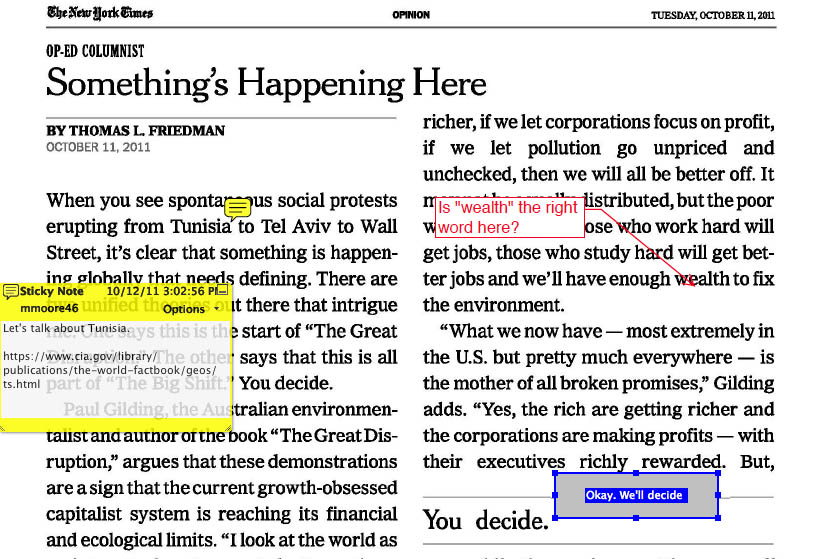
In preparation for discussing Friedman’s “Something’s Happening Here” tomorrow, I’m experimenting with some of the annotation and markup tools in Acrobat:

It’s been interesting to think about the range of platforms that people in class are using to read the NYT — in print, laid out on the table; on an iPad; on desktop computers; on laptops; on smart phones — and what this means for conventional forms of annotation. Do we, can we, should we, invent new forms?

Interesting genre: text, face, camera


[ from we are the 99 percent]